
Innovega
Data-led growth for an FDA-regulated eyewear $2.9M+ CF raise
Alex Wills, Director of Funding Growth at StartEngine (prior role).
$2.9M
Raised in the CF1 raise (approximate)
Closed March 30, 2026
1,084
Investors in the CF1 raise
Full campaign
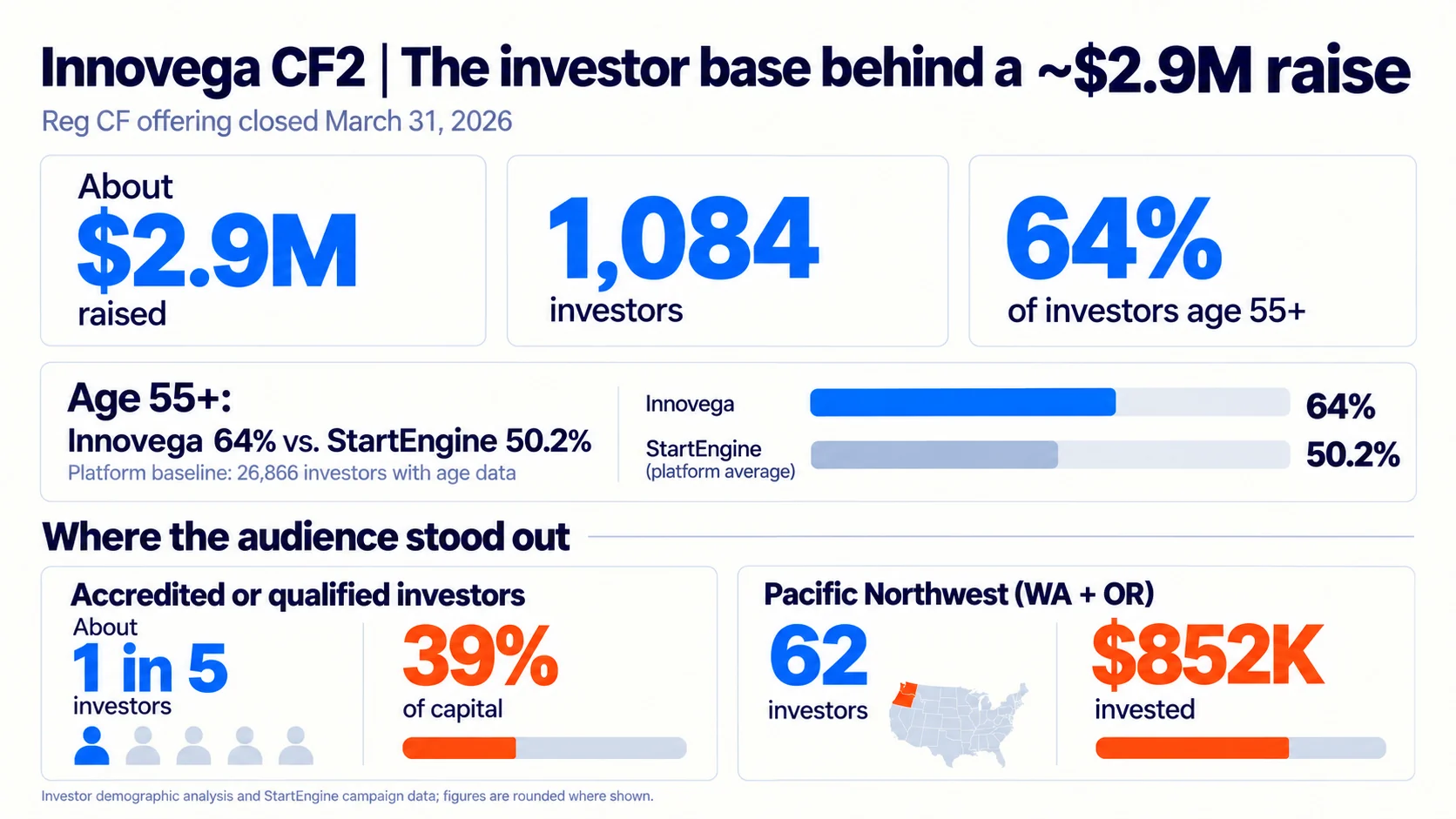
64%
Of investors aged 55 or older
Against 50.2% across StartEngine's baseline
39%
Of capital from accredited or qualified investors
About 1 in 5 investors
Alex's role: led campaign strategy and built the research, messaging, and creative workflows as StartEngine's Director of Funding Growth. Figures describe the completed CF1 raise and its investor data.
Overview
Innovega develops advanced smart eyewear, including glasses purpose-built for people with vision loss. Its CF1 raise, a Regulation Crowdfunding offering on StartEngine, closed on March 30, 2026 with about $2.9M raised.
As StartEngine's Director of Funding Growth, I led the campaign strategy and built the research, messaging, and creative workflows behind the raise, then carried what it taught us into Innovega's next offering.
Raise records
Innovega's raises on KingsCrowd
The challenge
Making an eyewear technology a credible investment
Smart eyewear for vision loss is easy to admire and hard to evaluate. Investors needed to see who the glasses help, what progress the company had made, and why this team could bring the product to market.
The raise also had to build something lasting: an investor base Innovega could come back to when its next offering launched.
Goals and scope
Goals
- Find out who was actually investing, and shape the message for them
- Tie the product story to proof and to the team's credibility
- Turn the updates investors responded to into ongoing follow-up
- Carry the investor base and the lessons into the next offering
What I worked on
- Raise strategy
- Investor data
- Messaging
- Ad copy
- Campaign updates
- Email sequence
- Investor landing page
- Investor webinar
- The next offering
The playbook
How I led the raise
-
Started with who was investing
I automated an issuer-facing demographic summary from StartEngine investor data. 64% of Innovega's investors were 55 or older, against 50.2% of the 26,866 StartEngine investors with age data in the platform baseline. Accredited or qualified investors were about one in five investors and 39% of capital.
Washington and Oregon together contributed more than $851K from 62 investors, led by Washington's $746K from 47. These findings sharpened the audience, geographic, and credibility-focused messaging.
-
Built a message and creative system
Human-guided automation drew on the campaign page, the Form C and other SEC filings, issuer questionnaires, and response data from the previous round. The messaging centered on independence, product progress, proof points, and the team's credibility.
I improved the automated social ad copy and routed it through preliminary compliance review, issuer approval, final compliance review, and then StartEngine's paid ads team.
-
Turned the strongest updates into an email sequence
I analyzed the campaign updates by engagement and offering clicks, then used the strongest themes, such as user testing, engineering progress, user reactions, and institutional validation, to shape a 12-email evergreen sequence. The Perkins School for the Blind update led the analyzed updates with a 7.33% offering-click rate.
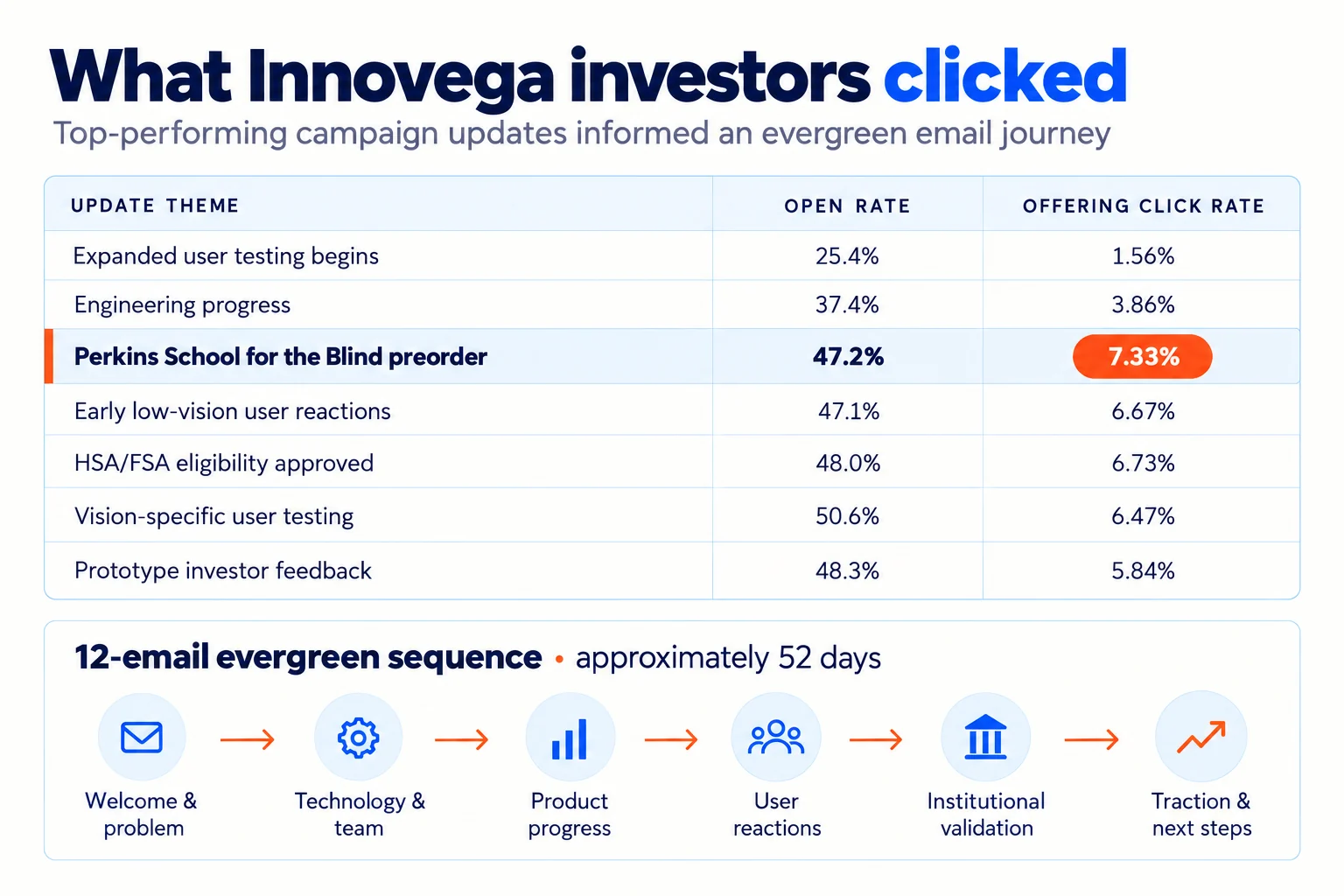
What investors clicked: the analyzed updates' open and offering-click rates, and the 12-email evergreen sequence they informed. -
Refreshed the story for the next offering
For the offering that launched on August 13, 2026, I compared the two campaign pages and offering terms, then turned what had changed into ad drips, landing page copy, and lead follow-up. The new story put Gen I production readiness, the manufacturing partnership, and more than $600K in product pre-orders up front, and left out clinical claims from the previous page that were out of date.
I steered the guidance on the investor landing page, connecting that story and its proof to a clear path to invest. I also coordinated launch creative and lifecycle email with the paid ads and creative teams, and aligned StartEngine's launch and early-bird promotions with the campaign calendar.
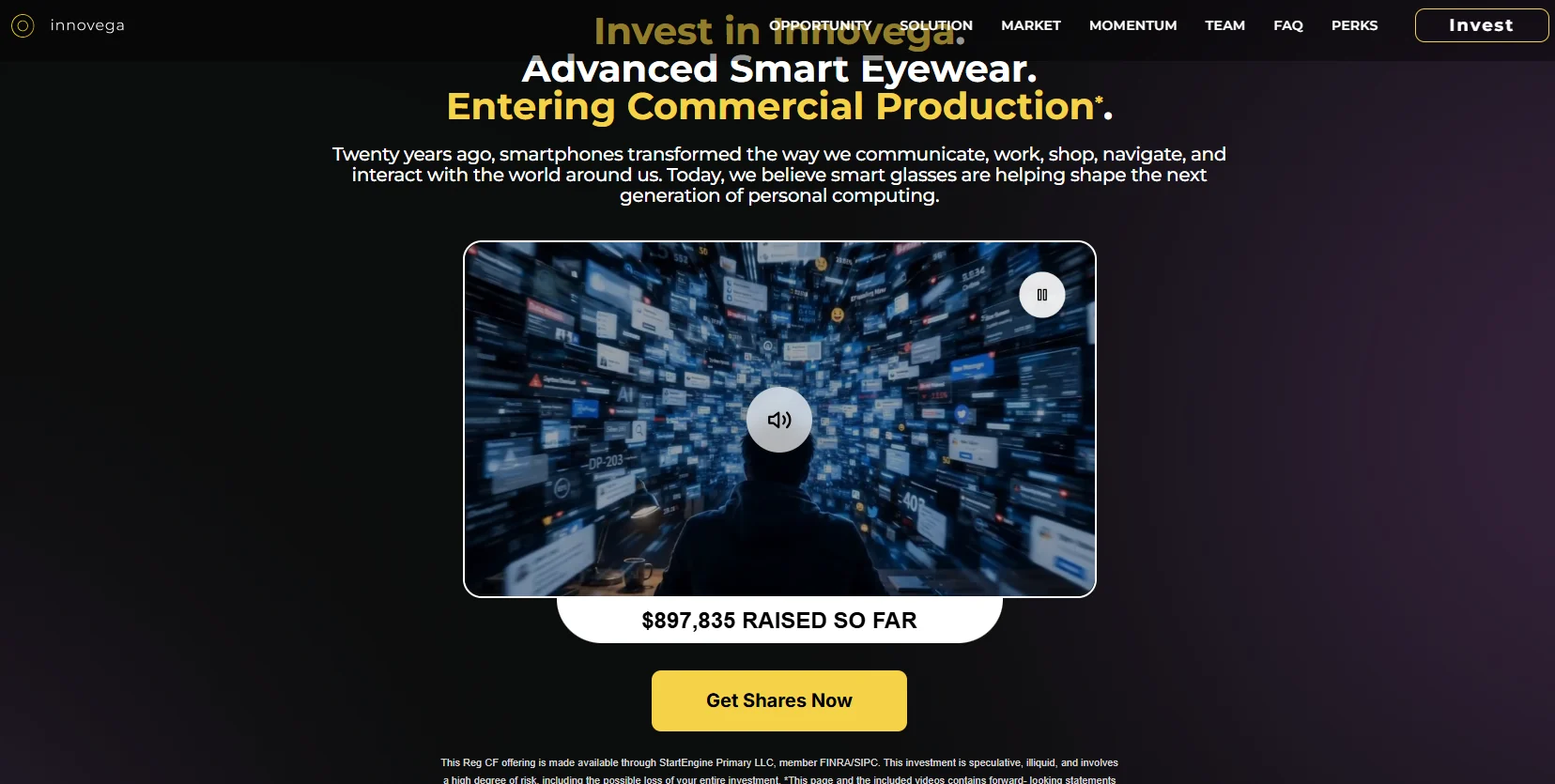
Innovega's investor landing page during its next offering. The amount raised and the offering details shown are from when the screenshot was taken. -
Wrote messaging for each stage of consideration
Product demonstrations and personal stories introduced Innovega to new audiences. For people who already knew the company, the messaging moved to the founder's experience and the business proof. The September 28, 2026 creative refresh covered existing videos, including Believing, Bev's Story, and Paul's Story, alongside a new concept built around vision loss.
- Product purpose
- “Purpose-built for vision loss” Made the intended use clear at once, giving investors a concrete problem and audience.
- Everyday independence
- “Binoculars for distance. A magnifier for reading. A scope for the TV across the room.” Opened Bev's Story with the burden of carrying several vision aids.
- Personal experience
- “Watch Paul's story and explore Innovega's investment opportunity.” Paired testimonial footage with a clear call to invest, without promising a product outcome.
- Founder credibility
- “From MicroVision to Innovega” Introduced Steve Willey's optics background as a reason to learn about the team.
- Returning visitors
- “You've Seen the Glasses. Meet the Team.” Moved the conversation from the product to the people executing.
- Investment consideration
- “Review Innovega's offering and see the investment details.” Gave interested viewers a next step without promising performance.
Copy review kept the story tied to the evidence. Claims without support, such as a growth figure and a launch date, were challenged, and partner consent, testimonial usage rights, product suitability, and medical-device wording were flagged for resolution.
Investor webinar
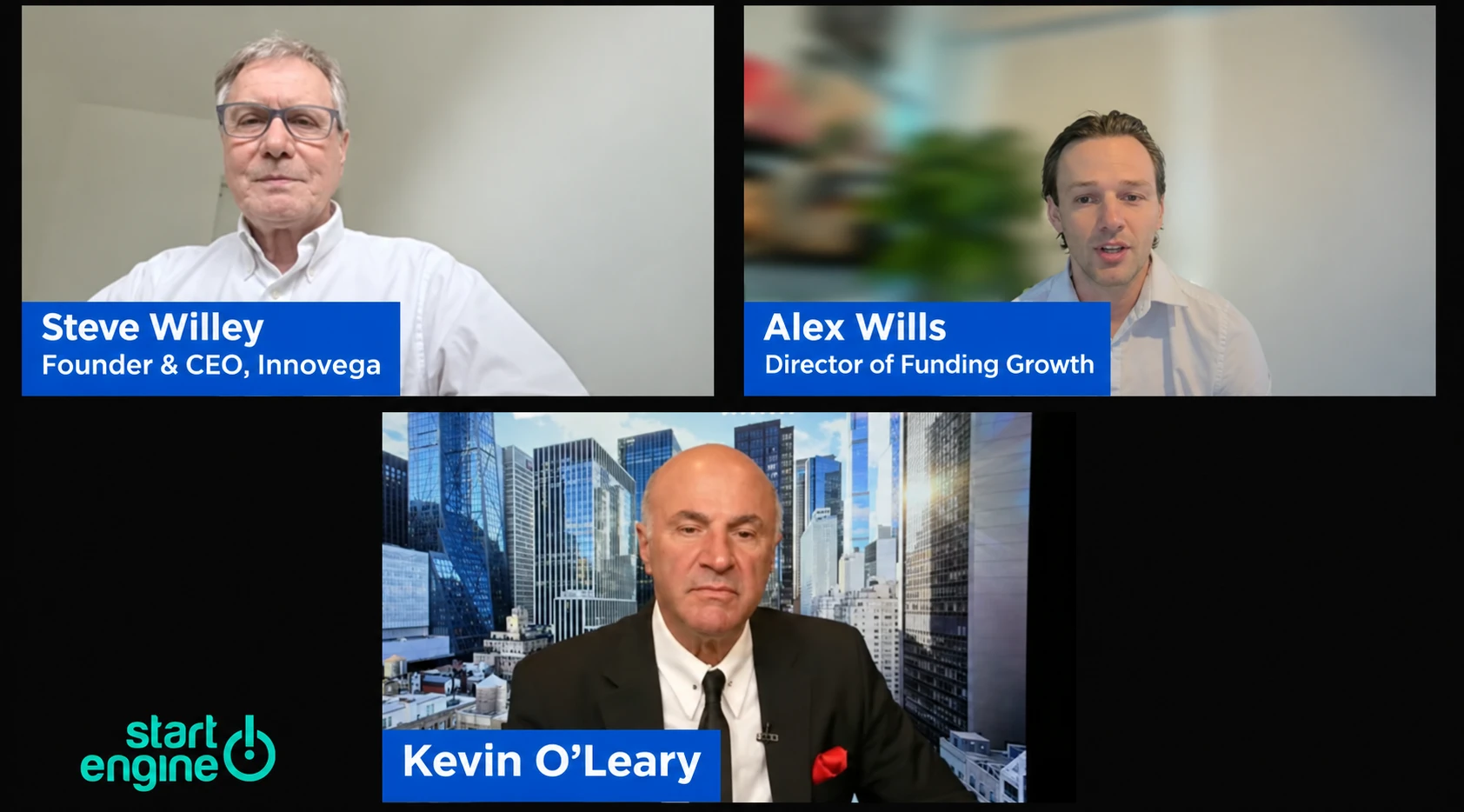
Interviewing Kevin O'Leary
During the CF1 raise, I interviewed Kevin O'Leary with Innovega's founder and CEO, Steve Willey, in a live webinar for investors on March 12, 2026. No investments are attributed to the webinar here.
Key moves
What changed in the campaign
- An automated demographic summary comparing Innovega's investors with StartEngine's baseline
- Messaging built from the offering documents, issuer inputs, and the previous round's responses
- An approval route for ad copy: compliance, issuer, final compliance, then paid ads
- A 12-email evergreen sequence built on the updates investors clicked most
- A refreshed story for the next offering, with outdated claims removed
- A live investor webinar with Kevin O'Leary and Innovega's founder
Results
The numbers
Each figure describes Innovega's raises on StartEngine, where I led the campaign strategy as Director of Funding Growth.
$2.9M
Raised in the CF1 raise (approximate)
Closed March 30, 2026
1,084
Investors in the CF1 raise
Full campaign
$3.44M
Raised across the activity in a later StartEngine report
From 1,226 investments; lifetime
11.53×
Lifetime marketing efficiency ratio (MER)
Same report; campaign level
$1.21M
From 175 returning investors
35% of capital in the same report
7.33%
Offering-click rate of the top update
Perkins School for the Blind update
Results in detail
What the numbers mean
The CF1 raise closed on March 30, 2026 with about $2.9M raised from 1,084 investors. It built an investor base Innovega could reengage in its next round. The available data does not assign a precise share of the raise to any one workflow.
A later StartEngine report recorded $3.44M raised from 1,226 investments across the activity it tracked, a lifetime marketing efficiency ratio of 11.53 times, $1.21M from 175 returning investors (35% of capital), and a 14.79% follower-to-investor conversion rate. That report and the CF1 total cover different scopes, so they are not added together. The marketing efficiency ratio is a campaign-level measure, not the return on any single ad or channel.
Open and offering-click rates come from the analyzed campaign updates. The investor age, accredited, and state figures come from the CF1 investor data; the StartEngine baseline is the 26,866 platform investors with age data.
Timeline
Campaign timeline
July 29, 2025
Innovega's CF1 Reg CF raise launched on StartEngine.
March 12, 2026
A live investor webinar with Kevin O'Leary and Innovega's founder and CEO, Steve Willey.
March 30, 2026
The CF1 raise closed with about $2.9M raised from 1,084 investors.
August 13, 2026
Innovega's CF2 Reg CF raise launched with a refreshed story, landing page, and launch creative.
September 28, 2026
A creative refresh of the top-performing videos, with a new concept built around vision loss.
November 9, 2026
The CF2 raise was still open.
Key learnings
Learning Experiences
- Research before creative. Offering documents, issuer inputs, earlier responses, and investor demographics framed a credibility-focused story, not a general consumer electronics pitch.
- Different messages for different stages. Product purpose and personal stories introduce the company; the founder's experience and the evidence give interested investors something to evaluate.
- Reuse what investors respond to. The updates that drew the most offering clicks became the themes of an evergreen email sequence, not one-time sends.
- Refresh the story between offerings. Comparing the old and new campaign pages kept the next raise focused on what had changed and removed outdated claims.
- Keep approvals explicit. Every piece of copy moved through compliance and issuer review before it reached the paid ads team.
FAQ
Questions about this case study
Why are there two raised amounts?
They are two different raises: Innovega's Reg CF raise launched in 2025, and its Reg CF raise launched in 2026.
What does the marketing efficiency ratio measure?
It is the report's campaign-level measure of efficiency across the whole campaign. It is not the return on any single ad or channel.
Can RaiseFM do this work on my raise?
RaiseFM works on the same decisions: the investor story, audiences, paid media, follow-up, and the close. The scope depends on your raise, your platform, and what your team already covers. A past result is not a promise of funding.
Tell us about your raise.
A few questions to help us understand your plans and where we can help.