

Tryperion Holdings
From one REIT to the beginnings of a syndication marketplace
Alex Wills, Marketing Director at Streitwise and Tryperion Holdings, April 2018 to December 2024 (prior role), then a consultant.
$8.35M
Investor commitments
Two offerings, 2022 and 2023
$4.53M
Victoria Multifamily Portfolio
Rule 506(b), Victoria, Texas, 2022
$3.81M
TH Trumbull
Rule 506(c), Trumbull, Connecticut, 2023
$1.4M
Attributed to Meta ads
January to February 2023, within the TH Trumbull total
Alex's role: Marketing Director, leading marketing for both offerings. Commitments are the totals recorded for each offering. The $1.4M is the part of the TH Trumbull total that Streitwise's reporting attributed to Meta acquisition and retargeting.
Overview
Streitwise's investor business was built around a single Reg A+ Office REIT. As Marketing Director, I helped launch two multifamily syndications under Regulation D, the beginnings of a marketplace of real estate offerings. Together they recorded $8,345,460 in investor commitments in 2022 and 2023.
Tryperion Holdings is the private equity real estate firm behind Streitwise, and it managed the offerings. Streitwise is the brand investors knew, so this page uses Streitwise for the marketing and Tryperion Holdings for the firm behind it.
The opportunity
Give existing investors more than one offering
Streitwise had built its investor base around one product: a non-traded Office REIT, open to investors of all wealth levels under Reg A+. Office real estate was struggling after Covid-19, and the REIT was Streitwise's only offering. Separate multifamily syndications gave investors a different kind of real estate, and gave Streitwise a second way to raise capital.
Each new offering needed more than a campaign: a place in a broader marketplace, a different subscription platform, legal coordination, and an acquisition plan that fit its rule. The first offering could not be advertised publicly. The second could.
Goals and scope
Goals
- Give Streitwise's investors real estate beyond the Office REIT
- Launch each offering with an acquisition plan that fit its rule
- Reach accredited investors beyond the existing audience
- Keep the marketing within each offering's rules, working with legal
What I owned
- Marketplace positioning
- Offering launch
- Juniper Square setup
- Existing-investor outreach
- Investor communications
- Meta acquisition and retargeting
- Google Search
- Landing pages
- Investor follow-up
Teams I coordinated
- C-suite
- Legal
The playbook
How the two offerings launched
-
Moved a single-REIT brand toward a marketplace
I worked with the C-suite to add the syndications and helped move Streitwise from one REIT toward a marketplace of real estate offerings. That meant connecting an established investor audience to new offerings, a different subscription platform, and acquisition suited to each offering's structure.
-
Launched a 506(b) offering through existing investor relationships
The first syndication was Victoria Multifamily Portfolio, multifamily real estate in Victoria, Texas, launched in 2022 under Rule 506(b). The rule does not allow general solicitation, so the offering was not advertised publicly. I focused acquisition on investor relationships Streitwise had built through its Reg A+ REIT, with legal coordination at the center of the launch.
I set up the offering in Juniper Square, worked with legal to bring it to launch, and ran investor communications and fundraising marketing. Victoria Multifamily Portfolio recorded $4,530,533 in investor commitments.
-
Launched a 506(c) offering with public marketing to accredited investors
The second offering was TH Trumbull, for The Royce at Trumbull in Connecticut, under Rule 506(c). The rule allows general solicitation, provided every purchaser is accredited and the issuer takes reasonable steps to verify it. That opened a route to accredited investors beyond Streitwise's existing audience.
I built the marketing for it: Meta acquisition and retargeting, Google Search, landing pages, qualification flows, and follow-up with investor education, webinars, and deal materials. The qualification questions sorted leads for follow-up. They were a marketing step, not the accredited-investor verification the rule requires.
Streitwise's reporting attributed $1.4M of the offering's total to Meta acquisition and retargeting, which ran in January and February 2023. TH Trumbull recorded $3,814,927 in investor commitments.
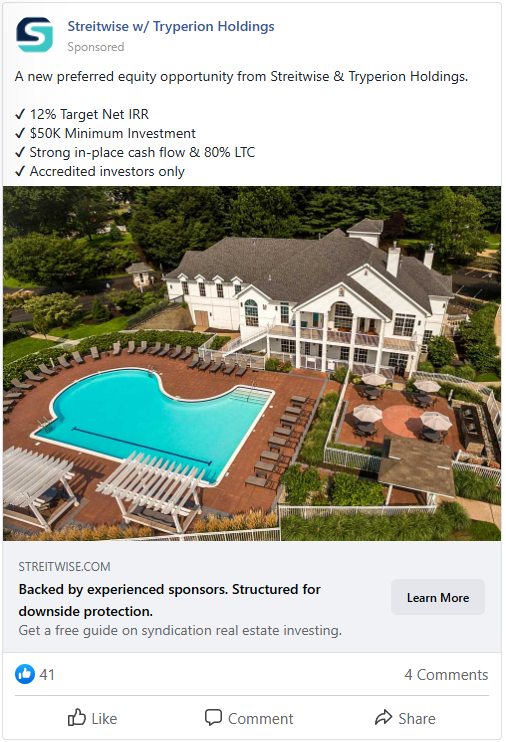
A Meta ad for the 506(c) offering, under the Streitwise with Tryperion Holdings name. Terms in the ad described the offering when it ran and are not realized returns. -
Ran both offerings as one process
I kept positioning, investor communications, campaign execution, and offering operations connected across both launches, so neither was a standalone advertising project. I also ran investor communications in Juniper Square, including funding updates.
Key moves
What changed
- A single-REIT brand moved toward a marketplace of real estate offerings
- A 506(b) launch built on existing investor relationships, with no public advertising
- Offering setup in Juniper Square, with legal involved from the start
- A 506(c) launch with public marketing to accredited investors on Meta and Google Search
- Qualification and follow-up through investor education, webinars, and deal materials
- Positioning, communications, campaigns, and operations run as one process
Results
The numbers
Commitments are the totals recorded for each offering in its entity dashboard. The $1.4M is the part of one offering that Streitwise's reporting attributed to Meta.
$8,345,460
Combined investor commitments
Two offerings, 2022 and 2023
$4,530,533
Victoria Multifamily Portfolio
Rule 506(b), Victoria, Texas, 2022
$3,814,927
TH Trumbull
Rule 506(c), Trumbull, Connecticut, 2023
$1.4M
Attributed to Meta acquisition and retargeting
January to February 2023, within the TH Trumbull total
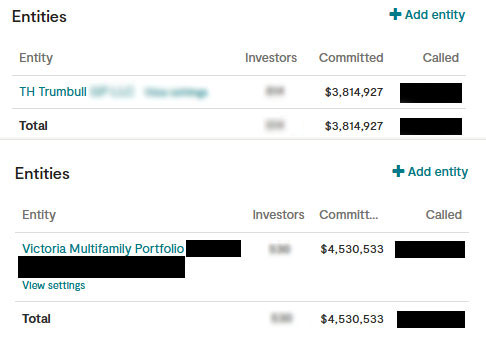
Results in detail
What the numbers mean
The $8,345,460 is the sum of two offerings' investor commitments: $4,530,533 for Victoria Multifamily Portfolio and $3,814,927 for TH Trumbull. Each is the committed total in the offering's entity dashboard.
These were separate offerings from Streitwise's Reg A+ Office REIT, so they are not part of the REIT's $20M+ total.
The $1.4M is investor capital that Streitwise's reporting attributed to Meta acquisition and retargeting for TH Trumbull in January and February 2023. It is part of that offering's $3,814,927, not additional to it.
Testimonials
From Streitwise's CEO and Forbes
Alex spearheaded the creation of several separate syndication offerings, helping raise $7.8 million.
His work includes strategic collaboration with the executive team on key decisions such as setting minimum investment thresholds and ensuring SEC compliance in the marketing campaigns.
His approach extends to the digital transformation of our investor portal, transitioning to a new platform with enhanced features that significantly improved the investor experience.
In addition, Alex's SEM strategies, content marketing, and paid campaigns resulted in a substantial increase in organic traffic, while his website redesigns and lead funnels formed the backbone of our marketing operations.
 Jeffrey Karsh Co-Founder and CEO, Streitwise
First-mover advantage and aggressive Google advertising campaigns have allowed them to build the largest presence in the crypto-asset IRA space, with close to 4,000 customers and $105 million in inflows since they began accepting funds in June 2016.
On Bitcoin IRA, where Alex led demand generation.
Key learnings
Learning Experiences
- The rule sets the marketing plan. A 506(b) offering and a 506(c) offering needed different acquisition from the first day.
- An existing investor base can support the next offering, within the rules. Legal belongs in the plan from the start.
- A new offering needs its operations ready before its marketing. The subscription platform, legal review, and investor communications came first.
- Public reach still needs follow-up. Ads started the conversation with accredited investors, and education, webinars, and deal materials carried it forward.
FAQ
Questions about this case study
How much of the $8.35M came from marketing?
Where a figure is attributed to one campaign, the page says so.
What is the difference between Rule 506(b) and Rule 506(c)?
Both are Regulation D exemptions for private offerings. Under Rule 506(b), the issuer cannot use general solicitation, such as public advertising, and can sell to accredited investors and up to 35 non-accredited investors who meet a sophistication standard. Under Rule 506(c), the issuer can advertise publicly, but every purchaser must be accredited, and the issuer must take reasonable steps to verify that status.
How does the marketing differ between a 506(b) and a 506(c) offering?
A 506(b) offering cannot be advertised, so it relies on relationships that exist before the offering, and counsel decides who can be approached and how. Being on a mailing list does not by itself create that kind of relationship. A 506(c) offering can use paid media, search, and landing pages to reach new accredited investors, so the work shifts to qualification, verification, and follow-up.
Can RaiseFM do this work on my Reg D raise?
RaiseFM works on the same parts of a raise: positioning, offering setup with your platform, investor communications, paid media where the rule allows it, and follow-up. Your counsel decides which rule applies and what the marketing can say. RaiseFM does not provide investor lists or introductions, and a past result is not a promise of funding.
Tell us about your raise.
A few questions to help us understand your plans and where we can help.